Yannima Tommy Watson: The Indigenous Master Who Redefined Modern Aboriginal Art
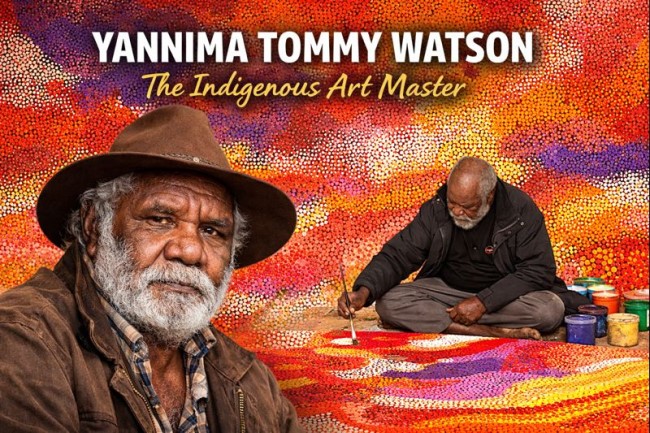
Yannima Tommy Watson stands as one of the most powerful and influential figures in contemporary Indigenous Australian art. Emerging later in life, his work transformed the global understanding of Aboriginal painting by blending deep cultural knowledge with bold abstraction and extraordinary use of colour. His paintings are not simple visual representations; they are emotional, spiritual, and geographic expressions of ancestral land, memory, and identity. This article explores his life, artistic philosophy, cultural significance, and lasting legacy in detail.
Early Life and Cultural Roots
Life on Country
Yannima Tommy Watson was born around the mid-1930s in the remote Western Desert region of Australia, near what is now the Irrunytju (Wingellina) community. Raised in a traditional Pitjantjatjara environment, he grew up deeply connected to his ancestral land, learning survival skills, ceremonial knowledge, and Dreaming stories passed down through generations.
Cultural Knowledge and Experience
Before becoming an artist, Watson lived a life shaped by the land. He worked as a stockman, labourer, and road builder, experiences that strengthened his understanding of movement across country, seasonal change, and sacred geography. This lived knowledge later became the emotional foundation of his paintings.
Journey Into Art
A Late but Powerful Beginning
Unlike many artists, Watson began painting seriously in his 60s. His entry into the art world coincided with the establishment of the Irrunytju Arts Centre, where senior men were encouraged to express cultural narratives through painting. Despite his late start, his talent was immediately evident.
Rapid Recognition
Within a few years, his works gained attention for their intensity, originality, and scale. Galleries and collectors recognised that his paintings were not decorative but deeply authoritative cultural statements.
Artistic Style and Technique
Bold Abstraction
Watson’s work is often described as abstract, yet it is deeply grounded in place. Rather than illustrating sacred stories directly, he used colour, movement, and layered dotting to evoke the emotional essence of country. This approach respected cultural protocols while allowing creative freedom.
Use of Colour
One of his defining features was his fearless use of colour. Fiery reds, electric pinks, deep purples, and luminous yellows dominate his canvases. These colours reflect desert heat, spiritual energy, and the vibrancy of ancestral presence.
Comparison to Global Modernism
Art critics often compare Watson’s work to modern abstract painters, yet his art remains distinctly Indigenous. His abstraction was not theoretical; it was experiential, rooted in lived connection to land rather than academic concepts.
Themes and Meaning
Country as Memory
Watson’s paintings represent country not as a map, but as memory. Each canvas captures movement across land, water sources, sacred paths, and ancestral journeys without revealing restricted knowledge.
Spiritual Authority
As a senior law man, his paintings carried cultural authority. This gave his work a sense of depth and gravity that resonated strongly with Indigenous and non-Indigenous audiences alike.
Major Exhibitions and Global Impact
National and International Recognition
Watson’s work was exhibited widely across Australia and internationally, including in major museums and prestigious art fairs. His inclusion in international collections positioned Aboriginal art firmly within the global contemporary art conversation.
Permanent Collections
His paintings are held in leading public collections, confirming his status as one of the most significant Indigenous artists of his generation.
Legacy and Influence
Redefining Aboriginal Art
Watson challenged stereotypes that Aboriginal art must follow rigid visual conventions. He demonstrated that Indigenous painting could be bold, experimental, and contemporary while remaining culturally authentic.
Influence on Younger Artists
Many emerging Indigenous artists cite his confidence, scale, and colour as inspiration. His success also highlighted the importance of remote art centres in nurturing world-class talent.
Personal Life and Character
Quiet Strength
Despite international acclaim, Watson remained grounded and closely connected to his community. He was known for his humility, generosity, and commitment to cultural responsibility.
Passing and Remembrance
He passed away in 2017, but his influence continues to grow. His artworks remain highly sought after, and his contribution to Australian art history is firmly established.
Why Yannima Tommy Watson Matters Today
Watson’s art speaks across cultures and generations. In a world increasingly disconnected from land, his paintings remind viewers of responsibility, memory, and belonging. His legacy is not only artistic but cultural, educational, and spiritual.
Quick Info: Yannima Tommy Watson
| Attribute | Details |
|---|---|
| Full Name | Yannima Tommy Watson |
| Cultural Group | Pitjantjatjara |
| Region | Western Desert, Australia |
| Art Style | Abstract Indigenous Painting |
| Known For | Bold colour, cultural authority, modern abstraction |
| Active Years | Early 2000s – 2017 |
| Legacy | One of the most influential contemporary Indigenous artists |
FAQs About Yannima Tommy Watson
Who was Yannima Tommy Watson?
He was a highly respected Indigenous Australian artist known for transforming Western Desert painting through bold abstraction and colour.
Why did he start painting late in life?
Cultural responsibilities and life circumstances meant he began painting seriously in his later years, bringing deep lived experience into his work.
What makes his art unique?
His use of intense colour, large-scale abstraction, and emotional representation of country set him apart from traditional styles.
Is his work symbolic or literal?
His paintings are symbolic and experiential, conveying the feeling of country rather than direct visual storytelling.
Why is he important globally?
He positioned Aboriginal art within global contemporary art, proving it could stand alongside the world’s most influential modern movements.
Final Thought
Yannima Tommy Watson was not just an artist; he was a cultural voice speaking through colour, rhythm, and memory. His work continues to inspire, challenge, and educate, ensuring his place among the great masters of modern art.