LiPo Battery vs AA / AAA Batteries: When to Use Which?
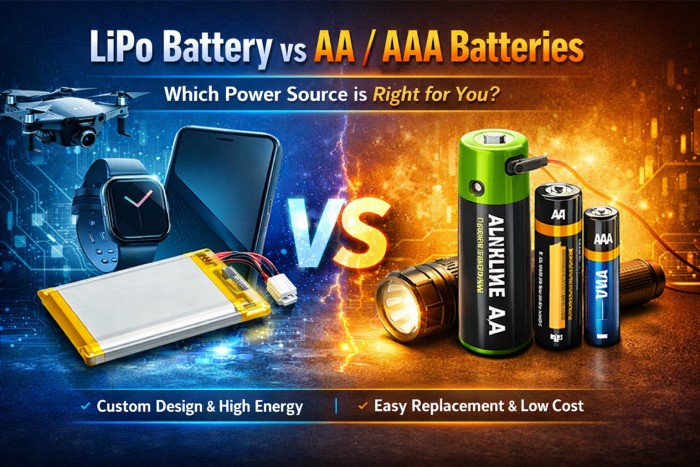
LiPo Battery vs AA / AAA Batteries: When to Use Which?
Choosing the right battery is more important than many people think. Power sources affect performance, safety, size, and product lifespan. Today, the debate often comes down to lithium polymer batteries versus traditional AA and AAA batteries.
This guide explains the differences in simple terms. It also highlights when working with a Custom Lithium Polymer Battery Manufacturer makes more sense than using standard batteries. Whether you design electronics or buy consumer devices, this comparison will help you decide wisely.
Understanding Lithium Polymer Batteries
Lithium polymer batteries, also called LiPo batteries, are rechargeable energy cells. They use a flexible polymer electrolyte instead of liquid. This design allows more freedom in shape and size.
A Custom Lithium Polymer Battery Manufacturer can build batteries to exact specifications. Voltage, capacity, thickness, and connector types can all be tailored. This flexibility is a major advantage in modern electronics.
LiPo batteries are widely used in smartphones, wearables, medical devices, drones, and IoT products.
Understanding AA and AAA Batteries
AA and AAA batteries are among the most common power sources worldwide. They are cylindrical and come in standard sizes. These batteries are available as alkaline, lithium, or rechargeable NiMH versions.
Many devices still rely on AA or AAA batteries due to their convenience. Remote controls, toys, clocks, and flashlights are common examples.
Recently, new options like the USB Type-C rechargeable AA & AAA battery have entered the market. These offer built-in charging without separate chargers, making them more user-friendly.
Key Differences Between LiPo and AA / AAA Batteries
1. Size and Shape Flexibility
AA and AAA batteries come in fixed sizes. There is no room for customization. Devices must be designed around them.
LiPo batteries are different. A Custom Lithium Polymer Battery Manufacturer can produce ultra-thin or uniquely shaped cells. This is ideal for compact or curved products.
If space matters, LiPo batteries win.
2. Energy Density
Lithium polymer batteries store more energy in less space. This means longer runtime without increasing size.
AA and AAA batteries offer limited energy. Multiple cells are often needed to match one LiPo battery.
High-performance devices benefit more from LiPo technology.
3. Rechargeability and Charging Options
Most LiPo batteries are rechargeable by default. They support fast charging and advanced power management.
AA and AAA batteries can be disposable or rechargeable. The USB Type-C rechargeable AA & AAA battery improves convenience, but capacity remains limited.
For frequent charging cycles, LiPo batteries provide better efficiency.
4. Voltage Stability
LiPo batteries deliver stable voltage throughout most of their discharge cycle. This ensures consistent device performance.
AA and AAA batteries experience voltage drops over time. Devices may slow down or stop unexpectedly.
Sensitive electronics perform better with LiPo batteries.
5. Safety and Protection
LiPo batteries require proper protection circuits. Overcharging or damage can cause safety risks. This is why choosing a reliable Custom Lithium Polymer Battery Manufacturer is critical.
AA and AAA batteries are generally safer for basic use. However, leaks and overheating can still occur.
With proper design, both options are safe.
When to Choose a Custom Lithium Polymer Battery Manufacturer
Working with a Custom Lithium Polymer Battery Manufacturer is the best choice in several situations:
- You need a custom size or shape
- Your device requires high energy density
- Space is limited
- Long-term recharge cycles matter
- You design professional or commercial electronics
Custom solutions also improve branding, performance, and product lifespan.
When AA or AAA Batteries Make More Sense
AA and AAA batteries are still useful in many cases:
- Low-power devices
- Products designed for easy replacement
- Emergency equipment
- Devices used by non-technical users
The USB Type-C rechargeable AA & AAA battery is ideal for users who want simple charging without redesigning devices.
Cost Considerations
AA and AAA batteries have a lower upfront cost. They are easy to replace and widely available.
LiPo batteries cost more initially. Custom designs increase the price. However, they reduce replacement needs and improve efficiency.
For mass production, custom LiPo batteries often lower long-term costs.
Environmental Impact
Disposable AA and AAA batteries create waste. Recycling is not always done correctly.
Rechargeable LiPo batteries reduce waste. They support sustainable product design when used responsibly.
The USB Type-C rechargeable AA & AAA battery also helps reduce disposable battery use.
Final Thoughts
There is no single best battery for every application. Each option serves a purpose.
If you need flexibility, power, and modern performance, working with a Custom Lithium Polymer Battery Manufacturer is the smart move. For simple devices and easy replacement, AA and AAA batteries remain practical.
As technology evolves, rechargeable solutions will continue to dominate. Choosing the right battery today can define the success of your product tomorrow.